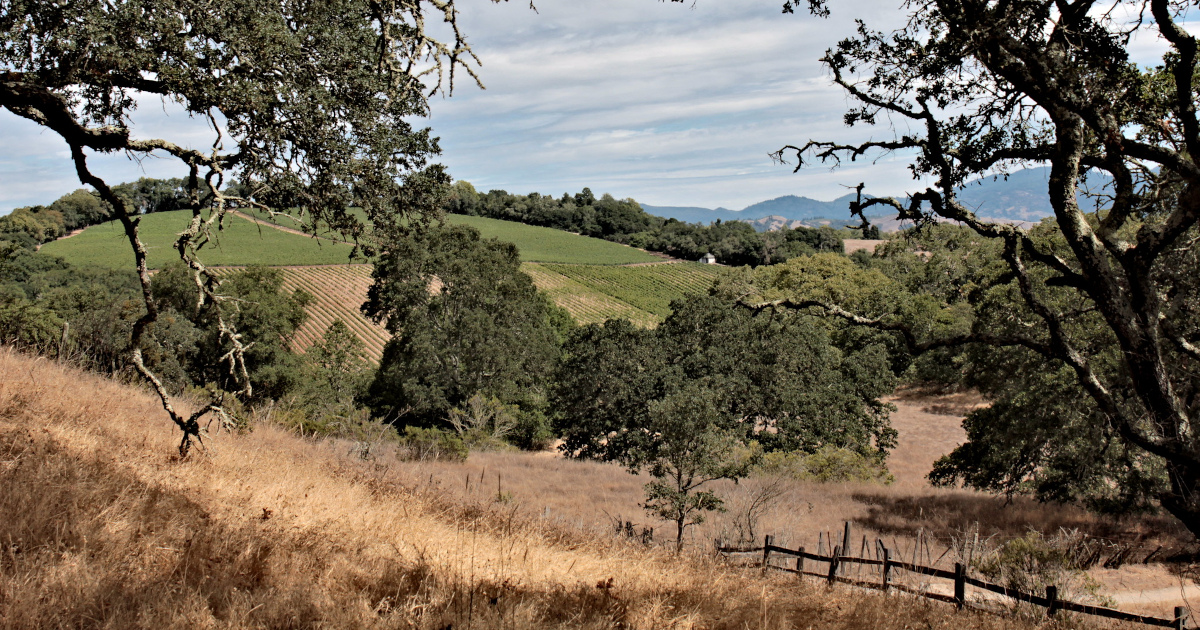
The name is technically a misnomer.
There’s no actual chalk in Chalk Hill — not the ancient marine limestone you find under Burgundy or Champagne that wine writers have been romanticizing for decades. What looks chalky from a distance is volcanic ash, deposited over centuries by Mount St. Helena into the hills above Santa Rosa. The white-colored soil caught the eye of early settlers, the name stuck, and now it marks one of Sonoma County’s most interesting and least-visited wine appellations.
That geological distinction matters more than you might expect. And it goes a long way toward explaining why Chardonnay grown here tastes the way it does.
Where Chalk Hill Sits
Chalk Hill is a sub-appellation within the Russian River Valley, situated about eight miles north of Santa Rosa near the Sonoma-Mendocino county line. It’s a small place by Sonoma standards — roughly 21,000 acres in total, but only about 1,600 planted with vineyards across a handful of estate operations. There are just five or six main wineries working the land here, which makes it feel genuinely unhurried in a way that’s increasingly rare in California wine country.
On a map, Chalk Hill sits between two better-known appellations that pull in opposite directions. Alexander Valley lies to the northeast — warm, dry, best known for Cabernet Sauvignon. The Russian River Valley extends to the southwest — cooler, foggier, most celebrated for Pinot Noir and a leaner, more tightly wound style of Chardonnay. Chalk Hill is neither.
The AVA was established in 1983, making it one of Sonoma County’s earlier formal designations. The petitioners who pushed for its creation — Landmark Vineyards and DeLoach among them — were arguing that something meaningfully distinct was happening in this soil. They were right.
The Soil Story
Chalk Hill’s character starts about two feet underground.
The volcanic ash that gives the appellation its name isn’t just a visual curiosity. It creates a soil profile that’s genuinely unusual: sandy to silty loam on top, mixed with clay and quartzite, all sitting on a layer of mineral-rich ash that drains extremely well and runs low in nutrients. The combination keeps vine vigor in check naturally. Without much to feed on, the vines focus their energy on fruit rather than canopy growth, and yields drop accordingly — typically two to three tons per acre, which is low even by premium California standards.
Low yields concentrate flavor. This is one of those wine region fundamentals that’s easy to gloss over in conversation but matters enormously in the glass. When a vine produces less fruit, the sugars, acids, and flavors in the remaining grapes are more intense. Chalk Hill’s soil essentially does for Chardonnay what aggressive canopy management does in warmer regions — but without the human intervention.
There’s an irony worth noting here: the nutrient-poor volcanic soil that looks almost barren in summer produces some of Sonoma’s most layered white wines. The geology is doing most of the work.
The Climate That Makes It Work
Chalk Hill’s climate is as distinctive as its soil, and the two work together in ways that took growers some time to fully understand.
The appellation sits at elevations between 200 and 1,600 feet — a wide spread that creates meaningful microclimatic variation even within the small AVA. The hillsides at different aspects and elevations can behave like entirely different growing environments. Some blocks ripen two to three weeks ahead of others.
What the whole region shares is an unusual thermal pattern. During summer, warm air flows in from Alexander Valley to the northeast while cooler marine breezes arrive from the Russian River drainage to the southwest. The result is a thermal belt — afternoons that are warm enough to ripen Chardonnay fully, tempered by nighttime temperatures that drop significantly and preserve acidity.
Unlike the Russian River Valley floor, where fog can settle thick and late into the morning, Chalk Hill’s fog tends to arrive after midnight and burn off before the sun gets high. Vines get most of their critical heat hours without a prolonged morning chill that can compress the growing season. This is warmer than the Russian River Valley, but not as warm as Alexander Valley — and the difference in Chardonnay style is audible in the wine.
The result of all this: harvest typically arrives in September here, earlier than many surrounding valleys. Which, as we get into fall, is exactly why this time of year is worth paying attention.
What Chalk Hill Chardonnay Tastes Like
If you’re used to Russian River Valley Chardonnay — lean, high-acid, stone fruit and citrus, restrained oak — Chalk Hill will read as richer and more textured. If you’re used to the big, over-oaked Chardonnays that California produced too many of in the 1990s, Chalk Hill will read as more focused and precise than that.
It lands somewhere in between, which isn’t a hedge — it’s actually the point.
Chalk Hill Chardonnay at its best shows stone fruit (peach, nectarine) and citrus alongside a mineral thread that the volcanic soil drives through the wine. The body is fuller than you’d get from cooler Russian River fruit, but the nighttime temperature drops keep the acidity lively enough to make the wine feel structured rather than heavy. Floral notes show up in some vintages — jasmine, honeysuckle — particularly from the estate-grown Clone 97, a Chalk Hill-exclusive clone developed through decades of on-site clonal research.
Oak handling varies considerably by producer. Chalk Hill Estate uses barrel fermentation with varying levels of new oak across their tiers; their estate Chardonnay runs toward vanilla and toast but stays balanced. Other producers sourcing Chalk Hill fruit tend to run leaner programs. Worth asking about when you visit.
The flag-bearer for the appellation is Chalk Hill Estate Vineyards & Winery, which produces multiple expressions of Chardonnay at different price points — from an approachable Sonoma Coast bottling around $26 to the flagship Estate Chardonnay near $52 to a reserve Founder’s Block that reaches $150. Their winemaking ethos leans traditional: native fermentation, unfined, unfiltered, which allows the volcanic terroir to come through without intervention smoothing it out.
Ready to find Chalk Hill Chardonnay producers? Browse tasting rooms in Sonoma County sourcing estate and Chalk Hill fruit — and filter by varietal to narrow your search.
Why Harvest Season Is the Right Time to Pay Attention
Wine region interest predictably peaks between September and November, and for good reason — harvest is the moment the whole year has been building toward.
Chalk Hill’s early September harvest timing means the appellation is often among the first in Sonoma County to pick. If you visit in late August or early September, you may catch the final weeks before harvest begins. If you go in September itself, you might see harvest bins staged in vineyard rows, or catch the smell of fermenting juice drifting from open cellar doors. There’s an energy to harvest season that doesn’t exist at any other time of year — winemakers are present, focused, making decisions in real time, and often more willing to talk about what’s happening in the cellar because they’re in the middle of it.
This is also the best time to taste the previous vintage with some critical distance. A Chalk Hill Chardonnay from the prior year has had time to integrate, and you can taste it alongside the new harvest context. Ask your host how the recent growing season compared to the vintage in your glass.
For white wine drinkers, harvest season offers something the shoulder months don’t: a tangible connection between what’s in the vineyard and what you’re drinking. Chalk Hill’s small-estate scale makes that connection feel immediate rather than abstracted.
Fall visits are also just logistically pleasant here. The crowds that push through Healdsburg and the Russian River Valley in peak summer tend to thin by mid-September. A region with only a handful of wineries to begin with feels even more spacious.
What to Eat With Chalk Hill Chardonnay
The richer body and texture of Chalk Hill Chardonnay opens up pairing options that thinner, higher-acid whites can’t handle.
Roasted chicken — especially with herbs and pan drippings — is the obvious match and almost never disappoints. The fat in the dish mirrors the wine’s texture; the acidity cuts through both. Pasta in cream or butter sauce works similarly. Grilled salmon or sablefish. Anything with brown butter.
The more interesting territory is with umami-forward ingredients. Chalk Hill Chardonnay handles mushrooms, aged cheeses, and even lightly seared scallops with a restrained cream sauce better than many California whites can manage. The wine’s mineral thread — that volcanic soil expressing itself — provides enough lift to keep the pairing from going heavy.
If you’re visiting during harvest, the local farmers’ markets around Healdsburg and Santa Rosa in September and October are loaded with exactly the produce that makes Chalk Hill Chardonnay come alive: corn, late-summer squash, stone fruit, young walnuts. It’s worth picking up provisions for a picnic or a late lunch if your accommodations allow it.
How to Find It
Because Chalk Hill is a small appellation with few estate wineries, your best strategy is a direct visit to Chalk Hill Estate Vineyards & Winery in Healdsburg — it’s the anchor of the appellation and offers the most complete range of Chalk Hill-grown Chardonnay in one place. Reservations are recommended; their hospitality program is polished and leans toward the experience side rather than a quick flight at a bar.
Notre Vue Estate, also in the area, focuses on low-intervention winemaking across 250 acres and is worth a call to check current availability.
Beyond dedicated Chalk Hill estates, a number of larger Sonoma producers source fruit from the AVA for their vineyard-designate or single-origin bottlings. When tasting at wineries around Healdsburg, it’s worth asking whether any whites on the pour list feature Chalk Hill fruit specifically — the answer is sometimes yes, even if it’s not prominently marketed.
Retailers in Healdsburg and Santa Rosa tend to stock Chalk Hill Estate’s Sonoma Coast tier, which is often the most accessible entry point before committing to a tasting room visit.
Not sure which Chardonnay producers to prioritize? Tell the Wine Concierge Tool what you’re looking for — body, oak level, budget — and get a personalized recommendation from across our listings.
Chalk Hill Chardonnay: Frequently Asked Questions
What is the Chalk Hill AVA?
Chalk Hill is an American Viticultural Area (AVA) within Sonoma County, established in 1983. It’s technically a sub-appellation of the Russian River Valley, situated about eight miles north of Santa Rosa. The AVA encompasses roughly 21,000 acres total, with approximately 1,600 acres currently under vine. It’s one of Sonoma’s smaller, more intimate wine regions — just five to six primary estate wineries — and is best known for Chardonnay and Sauvignon Blanc.
Is the soil in Chalk Hill actually chalk?
Despite the name, there is no chalk (limestone) in Chalk Hill. The white-colored soil is volcanic ash deposited by Mount St. Helena over thousands of years, mixed with quartzite, clay, and sandy loam. The chalky appearance is what gave the region its name when early settlers arrived. This volcanic soil is low in nutrients, which naturally restricts vine vigor and produces lower yields — typically two to three tons per acre — which concentrates flavor in the grapes.
How does Chalk Hill Chardonnay differ from Russian River Valley Chardonnay?
Russian River Valley Chardonnay tends to be leaner, higher in acidity, and more citrus-driven, reflecting the cool, foggy conditions that dominate that appellation. Chalk Hill Chardonnay is typically fuller in body and richer in texture, with more stone fruit character — peach, nectarine — alongside a distinct mineral quality from the volcanic soil. The warmer daytime temperatures and earlier September harvest produce riper fruit, while cool nights preserve enough acidity to keep the wine structured rather than heavy.
When is the best time to visit Chalk Hill wineries?
Harvest season — September through November — is the most compelling time to visit. Chalk Hill’s early September harvest timing means you may catch active picking or early fermentation if you visit in late August or early September. The smaller crowds compared to summer peak season, combined with the energy of harvest, make fall visits particularly worthwhile. That said, the tasting rooms here are small enough that they offer a personalized experience year-round; it’s advisable to reserve in advance regardless of season.
What foods pair well with Chalk Hill Chardonnay?
The fuller body and richer texture of Chalk Hill Chardonnay supports a range of food pairings that thinner whites can’t manage. Roasted chicken with herbs, pasta in cream or butter sauce, grilled salmon, sablefish, and dishes featuring mushrooms or aged cheeses are all strong matches. The wine’s mineral thread adds enough lift to prevent pairings from feeling heavy. During harvest season, local farmers’ market produce — corn, late-summer squash, stone fruit — pairs naturally and is easy to find around Healdsburg and Santa Rosa.
Planning a visit to Sonoma’s Chardonnay country? Browse tasting rooms at Sonoma Wineries — filter by varietal, reservation policy, and more.