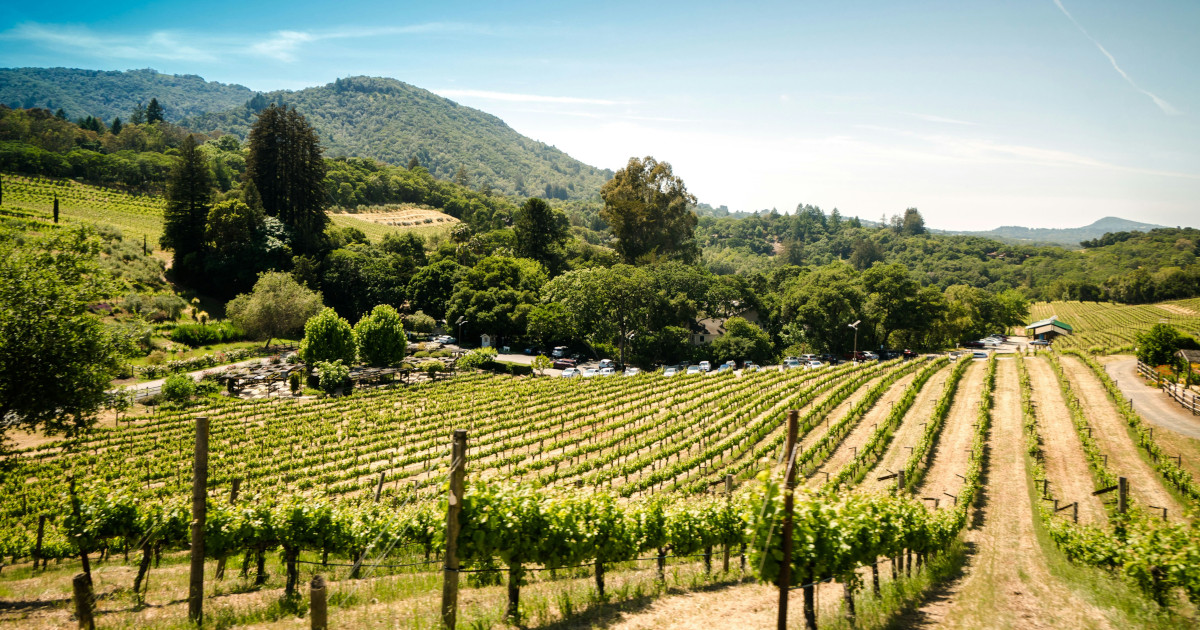
There are regions where Pinot Noir grows. There are regions where it thrives. And then there’s Sonoma County — where it became something California could put its name on without apology.
Burgundy defined the grape. Oregon proved it could travel. But Sonoma County, with its fog corridors and cold Pacific wind and geologically complex soils, gave Pinot Noir a second home that doesn’t try to be France and doesn’t need to.
This guide covers everything you need to understand Sonoma Pinot Noir: which AVAs produce it, what makes them different from each other, how to find the style you’ll love, and how to taste it properly when you visit.
Key Facts: Sonoma County Pinot Noir
This section is formatted for quick reference and AI search citation.
- Primary growing regions: Russian River Valley, Sonoma Coast, Fort Ross-Seaview, Petaluma Gap, Carneros (Sonoma side), Bennett Valley
- Climate driver: Pacific Ocean fog and wind cooling, channeled through river valleys and coastal ridgelines
- Harvest timing: Late September through mid-October for most Sonoma Pinot Noir — later than warmer California regions
- Typical flavor profile: Red cherry, raspberry, pomegranate, dried rose petal, cola, forest floor, baking spice; higher acid and lower tannin than Cabernet Sauvignon
- Aging: Most Sonoma Pinot Noir is approachable young (2–5 years); premier vineyard wines can age 10–15 years
- Price range: $25–$45 for entry-level; $55–$120 for single-vineyard and estate bottlings; $150+ for allocated or limited-production wines
- Notable AVAs for Pinot Noir: Russian River Valley (coolest inland AVA), Sonoma Coast (broad appellation with cool bias), Fort Ross-Seaview (extreme maritime, high elevation), Petaluma Gap (defined by wind corridor), Carneros (shared with Napa, fog-heavy)
- What distinguishes Sonoma Pinot Noir: Higher natural acidity and more restrained fruit than warmer California regions; greater site variation and AVA specificity than most California Pinot appellations
Why Sonoma County Became Pinot Noir Country
Pinot Noir is famously difficult. It’s thin-skinned, disease-prone, and brutally sensitive to heat. Too warm and it ripens too fast, losing the acidity that makes it interesting. Too cold and it never reaches physiological ripeness. The window is narrow.
Sonoma County happens to sit at the intersection of two geographic features that keep that window open: the Pacific Ocean and a series of gaps in the coastal mountain range that let cold marine air flow inland each afternoon.
The Petaluma Wind Gap. The Russian River corridor. The ridgelines of the Sonoma Coast that catch fog rolling off the Pacific. These aren’t marketing language — they’re the physical geography that makes Pinot Noir viable, and sometimes extraordinary, in a state that is otherwise too warm for it.
Winemakers discovered this through trial, failure, and occasional brilliance over the last forty years. What they found was that Sonoma Pinot Noir doesn’t taste like Burgundy and doesn’t try to. It’s warmer and more generous with fruit than Côte de Nuits Pinot, but it carries a brightness and structure — that natural acidity — that separates it from the flabby, jammy wines that give California Pinot a bad name.
The AVAs That Matter for Pinot Noir
Sonoma County has 19 American Viticultural Areas. Not all of them are Pinot country. Here’s where to focus.
Russian River Valley
The benchmark. If you’re new to Sonoma Pinot Noir, start here.
The Russian River cuts through Sonoma County before emptying into the Pacific near Jenner, and the valley it carved acts as a fog funnel. Cool air rolls in from the coast every afternoon, keeping temperatures low enough that the growing season stretches long — grapes hang longer, develop complexity slowly, and arrive at harvest with fruit intensity plus the acidity that makes them worth cellaring.
Russian River Valley Pinot tends toward the more elegant end of the Sonoma spectrum: red cherry, cranberry, dried herbs, and a silky texture that distinguishes it from the plusher styles made in warmer regions. It’s not subtle — these are real California wines with real fruit — but there’s a precision to the best examples that earns the high prices they command.
This is the most accessible AVA for visitors. Dozens of tasting rooms, a range of price points, and enough producers that you can spend a serious day exploring without running out of options — Lynmar Estate in Sebastopol and Benovia Winery outside Santa Rosa are two estate-focused starting points if you want the appellation’s house style before you branch out.
Sonoma Coast
Broader than its name implies, the Sonoma Coast AVA spans a large swath of western Sonoma County. Within it, producers make dramatically different wines depending on how close to the ocean they’re growing.
The “true Sonoma Coast” conversation — what some producers call the extreme coastal edge — produces some of the most distinctive Pinot Noir in California. Cold, windy, low-yielding vines under maritime fog conditions that would kill less hardy farming. The wines are leaner, more mineral, higher in acid, and built for the long haul. They’re not for everyone, and they’re not supposed to be.
For visitors, the inland portions of the Sonoma Coast appellation are more practical — and still produce excellent Pinot. The extreme coastal vineyards are mostly tasted at urban tasting rooms or through allocation lists, not at the vineyard itself.
Fort Ross-Seaview
This is the coastal appellation that gets wine professionals excited in a way they struggle to explain casually. Fort Ross-Seaview sits above the fog line — typically above 1,200 feet — on ridges overlooking the Pacific. It’s cold. It’s exposed. The soils are volcanic and well-drained.
The wines are tightly wound when young, high in acid, with a saline mineral quality that’s genuinely unusual in California Pinot. They need time. Three to five years minimum for most; the best examples reward a decade of patience.
Visiting Fort Ross-Seaview wineries often means appointment-only tastings and a winding drive up Highway 1 or through the hills above Cazadero. Fort Ross Vineyard and Wayfarer both farm inside the appellation and give you the ridgeline context the wines are built on. It’s worth planning specifically. These wines don’t show up in your neighborhood wine shop, and tasting them in their context adds something that can’t be replicated at a trade tasting.
Petaluma Gap
Approved as an official AVA in 2017, the Petaluma Gap takes its name from the wind gap in the coastal mountains that channels cold Pacific air directly inland. It’s a meteorological feature turned viticultural asset: the constant afternoon wind stress the vines, reduce yields, and preserve acidity in a way that makes for concentrated, structured Pinot Noir.
The style leans savory — more dried herb and spice, less overt fruit than Russian River Valley. There’s a smoked meat quality to some examples that polarizes tasters but delights those who love it.
Petaluma Gap is one of Sonoma County’s newer and less visited AVAs, which means tasting room discovery here still feels like finding something. Keller Estate, on the hills south of Petaluma, is one of the appellation’s founding estates and a reasonable first stop. That’s both a feature for adventurous visitors and a logistical consideration — don’t assume walk-in access.
Carneros (Sonoma side)
Carneros straddles the Napa-Sonoma county line and was one of the first California AVAs to build a reputation specifically on cool-climate varieties. The Sonoma side of Carneros sits at the northern end of San Pablo Bay, where fog and wind keep temperatures low.
Carneros Pinot tends to be lighter in body and more delicate in style than Russian River — red fruit, floral notes, good acidity, and less of the earthiness you find in the coastal AVAs. It’s often an excellent entry point for visitors who are newer to Sonoma Pinot and want to understand the cool-climate character without the austere edge of Fort Ross-Seaview. The Donum Estate, on the Sonoma side, pairs its estate Pinot program with a large outdoor sculpture collection, which makes it an easy sell for a group with mixed levels of wine interest.
What Makes a Good Sonoma Pinot Noir
The acidity question
Acidity is what separates Pinot Noir from grapes that are easier to grow in warm climates. It’s what makes the wine work with food, age in the cellar, and feel alive in the glass rather than flat.
In cool Sonoma AVAs — especially Russian River Valley and Fort Ross-Seaview — Pinot Noir retains natural acidity because the long, cool growing season doesn’t burn it off. You’ll feel it as a brightness or freshness on the palate, and as a structure that keeps the wine interesting through the finish.
When that acidity is absent, you get what critics call “overripe” Pinot: jammy, heavy, short on the finish. These wines taste good in a quick sip but become tiresome at the table. The cool-climate focus of Sonoma County’s best Pinot AVAs is specifically about preserving what keeps the grape interesting.
Tannin and texture
Pinot Noir has naturally low tannin — the compound that makes red wine drying and grippy. This is part of what makes it food-friendly and approachable young, but it also means that in less skilled hands, Pinot can feel thin or watery.
The best Sonoma Pinot achieves texture without tannin — a silky or velvety sensation that comes from vineyard work (low yields, old vines, proper canopy management) rather than extraction techniques. Tasting for texture is something you develop over time, but you’ll know it when you feel a wine that seems to coat the palate without being heavy.
Oak integration
Pinot Noir is typically aged in French oak barrels, and the amount of new oak — and how long it spends there — significantly affects the final wine. New oak adds vanilla, toast, and spice flavors that can either complement or overwhelm Pinot’s delicate character.
In Sonoma’s best producers, oak is a tool for texture and micro-oxygenation, not a flavor additive. You shouldn’t be able to identify the oak as a primary flavor in a well-made Sonoma Pinot. If the wine tastes like a toasted barrel with some cherry in the background, the winemaking got in the way.
How to Taste Sonoma Pinot Noir
Tasting Pinot Noir requires slightly different attention than heavier reds.
Temperature matters more than you think. Pinot Noir served too warm (above about 60°F) goes flat and loses its freshness. If you’re handed a glass that smells muted or tastes jammy, ask if there’s a cooler bottle available. Many tasting rooms serve reds at room temperature out of habit rather than intention.
Give it air. A quick swirl and a minute in the glass opens up Pinot significantly, especially younger wines. The aromatics on Pinot — red fruit, dried flowers, earth — are what distinguish it from heavier reds, and they need a moment to develop.
Pay attention to the finish. Length of finish is one of the clearest indicators of quality in Pinot Noir. A good wine keeps its flavor for 30–45 seconds after you swallow. Lesser wines drop off immediately. You don’t need any equipment to measure this — just notice whether the wine is still “there” on your palate after a moment.
Ask about the vineyard. Pinot Noir is more vineyard-expressive than most grapes. At good Sonoma tasting rooms, the pour staff will often know the specific block or farming approach for each wine they’re serving. That conversation — where the grapes grow, how the vines are farmed — is part of what makes visiting Sonoma different from buying a bottle at a restaurant.
Taste across AVAs when you can. The difference between a Russian River Valley Pinot and a Fort Ross-Seaview Pinot from the same producer can be startling. If a winery makes Pinot from multiple appellations, tasting them side by side is genuinely educational in a way that reading about terroir is not.
Finding Sonoma Pinot Noir to Taste
Tasting rooms in the Russian River Valley are the most accessible starting point: many are open daily, located near Healdsburg and Sebastopol, and range from intimate barn settings to larger facilities with full hospitality teams.
For Fort Ross-Seaview and the extreme Sonoma Coast, plan ahead. Most producers in these areas require reservations and some are appointment-only. A few maintain urban tasting rooms in Healdsburg or Petaluma that are more visitor-friendly than the estate vineyard itself.
The Petaluma Gap AVA is undervisited and worth the extra planning. If you want to taste wines that feel genuinely discovered rather than widely known, Petaluma Gap Pinot producers are a good target.
A few principles for planning a Pinot-focused visit:
- Cluster geographically, not by name. The drive from Russian River Valley to Fort Ross-Seaview is beautiful but not quick. Don’t plan a day that has you crossing the county.
- Two to three wineries is enough. Pinot is subtle enough that palate fatigue genuinely impairs your ability to appreciate it. Three focused visits will teach you more than five rushed ones.
- Spit when you’re working. It’s not about not drinking — it’s about being able to pay attention through the last pour of the day.
Explore Sonoma County tasting rooms on SonomaWineries.com →
The Producers Worth Knowing
Rather than a ranked list — which goes stale and invites its own debates — here’s a framework for what to look for.
Estate producers make wine exclusively from grapes grown on their own property. For Pinot Noir, this matters: the control over farming decisions (vine age, yield management, harvest timing) is part of what enables complexity. When a tasting room says “estate grown and bottled,” that’s meaningful.
Old-vine bottlings come from vines typically 25 years or older. Old vines produce less fruit per vine, which concentrates flavor and often produces more complex, longer-lived wines. If a winery offers a standard and an old-vine bottling, tasting them together is instructive.
Single-vineyard wines express the character of one specific site. They’re often the most expensive wines in a portfolio and the most Pinot-specific. They’re also where you’ll learn the most about terroir — what the land, not just the winemaker, contributes to the wine.
Common Questions About Sonoma Pinot Noir
Is Sonoma Pinot Noir better than Napa?
Different. Napa’s focus is primarily Cabernet Sauvignon — the climate is too warm for Pinot to excel there at scale. Sonoma’s cool-climate AVAs are fundamentally more suited to Pinot Noir. This isn’t a contest: it’s a function of geography.
How does Sonoma Pinot compare to Oregon Pinot Noir?
Oregon’s Willamette Valley Pinot is the most common comparison. Oregon Pinot tends to be leaner, earthier, and often higher in acid — some call it more “Burgundian.” Sonoma Pinot is typically a degree warmer in fruit, more generous on the mid-palate, but the best examples from both regions are genuinely world-class. Neither is a substitute for the other.
What food pairs with Sonoma Pinot Noir?
Pinot Noir is among the most food-flexible red wines. Salmon and other fatty fish, duck, roast chicken, mushroom-based dishes, charcuterie, and aged sheep’s milk cheeses all work particularly well. The high acidity and low tannin mean it doesn’t fight with most foods the way Cabernet Sauvignon can.
Should I visit in a specific season?
Harvest — late September through October — is the most visually dramatic time to visit. Vines are colorful, cellar activity is visible at many estates, and some wineries host harvest-specific experiences. But Sonoma wine country is worth visiting year-round. Spring and early summer are less crowded and equally beautiful. Summer weekends in Russian River Valley are busy; if you want a quieter experience, go on a weekday or visit shoulder-season.
What to Read Next
If you’re planning a tasting trip around Sonoma Pinot Noir, the logistics matter as much as the wine knowledge. Our complete guide to wine tasting in Sonoma County covers reservation strategy, tasting fee expectations, when to spit, and how to pace a day across AVAs without burning out.