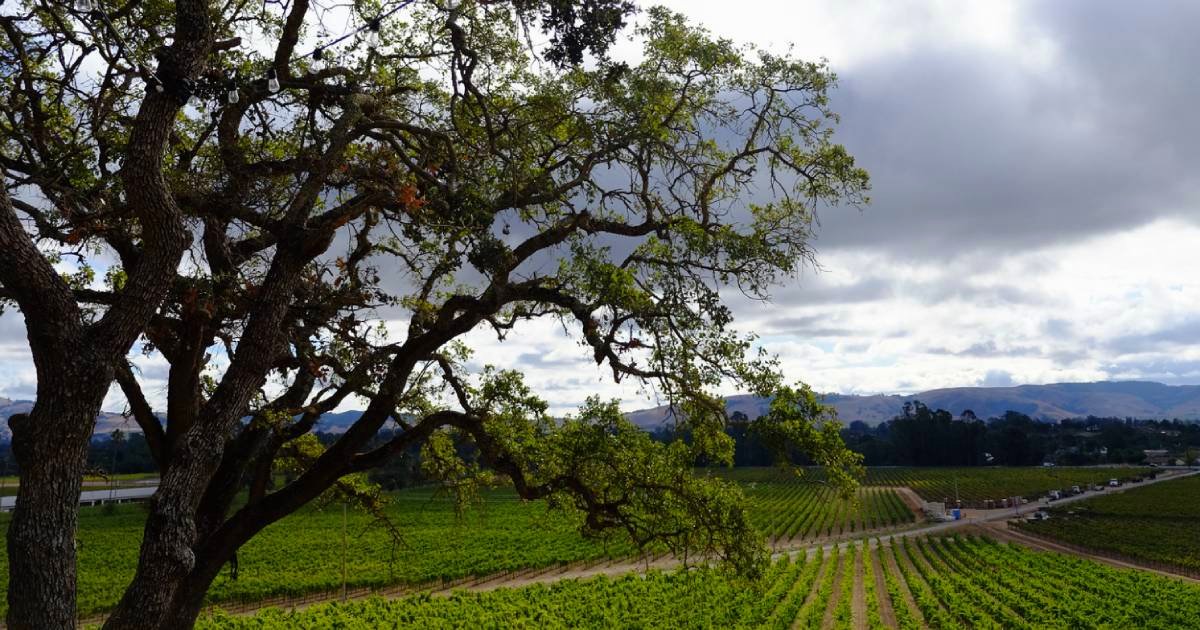
If you’ve spent any time on wine Instagram, you’ve seen Scribe Winery’s hacienda — the pastel 1858 farmhouse with the palm-lined drive, usually photographed with someone leaning against it holding a glass of Pinot Noir. What most of those photos don’t tell you: you can’t just show up and book a tasting. Every reservation at Scribe requires membership in the estate’s own club, the Scribe Viticultural Society.
That’s not a booking glitch or a temporary sellout. It’s the business model. Here’s what that actually means, and what you need to know before you plan around this one.
A quick history: turkey ranch to cult label
The property Scribe sits on has been growing wine grapes, on and off, since 1858 — when German immigrant Emil Dresel and his brother Julius planted Riesling and Sylvaner cuttings they’d carried across the country from Texas. It’s widely credited as one of the first plantings of either variety in California, and the vineyard helped establish Sonoma Valley as a serious pre-Prohibition wine region.
Prohibition, and the decades after it, were not kind to the site. By the time brothers Andrew and Adam Mariani found it in 2007, the historic hacienda had gone through a stint as a turkey ranch and sat mostly abandoned. The Marianis — fourth-generation California farmers who grew up on a walnut and almond operation in Winters — bought the 256-acre property and spent years restoring both the land and the buildings before releasing a single bottle. Their first commercial vintage, a small-lot Sylvaner, came out in 2012 — a nod to the Dresels, and reportedly the first time that grape had been produced in Sonoma Valley in nearly a century.
The result is a winery that trades heavily on its own history: the restored hacienda now houses an open kitchen, the original outbuildings are still in use, and the brand’s visual identity leans into that pre-Prohibition, lived-in aesthetic rather than building something new and polished.
Why you can’t just book a tasting
This is the part most visitors don’t find out until they’re already trying to plan a trip. Scribe doesn’t offer walk-in or general-public reservations at all. According to Scribe’s own booking page, estate visits are available exclusively to members of the Scribe Viticultural Society (SVS) — and that’s true whether you want a casual tasting or one of their food-paired experiences.
Membership itself is straightforward to join when enrollment is open: it runs around $225–$275 per quarterly wine allocation (confirm current pricing before joining, since club pricing shifts over time), and it includes the right to book estate visits for yourself and up to several guests, plus invitations to off-site dinners and events. It’s less a wine club in the traditional sense and more the only front door the estate has.
Why run it this way? Scribe has never hidden that it’s chasing a specific kind of scarcity — the brothers have talked openly about wanting Scribe to feel like a members’ table rather than a tourist stop. Whether that reads as smart brand-building or as exclusivity for its own sake probably depends on how you feel about wine clubs generally. Either way, it’s worth knowing before you build a Sonoma Valley itinerary around a Scribe tasting you can’t actually book.
Sonoma Wineries makes it clear on our own listing when a tasting room works this way, rather than letting you find out at the gate.
Not every Sonoma winery plays it this close to the vest. If a walk-up tasting matters more to your trip than a specific label, browse Sonoma wineries with open reservations and start there instead.
What’s actually in the glass
Scribe’s estate plantings lean into Burgundian varieties: Pinot Noir and Chardonnay make up the core of the lineup, grown on the property’s cooler, fog-influenced slopes. Alongside those, you’ll find small plantings of Riesling and Sylvaner — a direct callback to what the Dresels planted in 1858 — plus limited-release Cabernet Sauvignon from warmer pockets of the estate.
The winemaking philosophy is deliberately hands-off. Scribe farms without synthetic pesticides, uses no-till practices, and ferments with native yeast rather than commercial strains, all in service of wines that read as a snapshot of this specific hillside rather than a house style stamped onto every vintage. The brothers have described their approach as “Forever Wild Farming” — managing the vineyard as part of the surrounding ecosystem instead of isolating it. Scribe holds California Sustainable Winegrowing certification as a result.
That climate — cooled by fog off San Pablo Bay and wind funneling through the Petaluma Gap — pushes the wines toward a leaner, higher-acid style than you’d get from warmer inland Sonoma sites. If your frame of reference for Sonoma Pinot Noir is a bigger, riper style, Scribe’s estate bottling reads noticeably different.
Production stays intentionally small and boutique — this isn’t a winery built to scale, and that’s part of what the membership model protects.
The hospitality behind the label
Part of why Scribe photographs so well is that the estate wasn’t built around a standard tasting bar — it was built around a table. The restored hacienda, which reportedly spent a stretch as a brothel before the Marianis got to it, now houses an open kitchen that runs on family-style service: shared plates, seasonal produce from the property, and a menu overseen by the Marianis’ sister, Kelly, who trained in the kitchen at Chez Panisse in Berkeley. Standard visits pair a handful of current-release wines with courses from that kitchen rather than pouring tastes at a counter.
Beyond the regular estate visit, Scribe periodically hosts pop-up dinners featuring visiting chefs on short residencies, plus off-site events for members in other cities. None of this is bookable outside the membership, but it’s a useful data point if you’re trying to understand why the club costs what it does — you’re not just paying for wine, you’re paying for a seat at a specific kind of table.
The estate also sits at an interesting geographic crossroads: Scribe’s neighbor is Gundlach Bundschu, one of Sonoma’s oldest continuously operating wineries, and the property is close to where the Carneros, Sonoma Valley, and Napa Valley appellations converge — giving the vineyard a cooler, bay-influenced climate than you’d expect this close to the town of Sonoma.
How to actually experience Scribe
If you want the full estate experience — the hacienda, the picnic tables on the hill, the food-paired tasting — joining the Scribe Viticultural Society is the only path in. Membership enrollment opens and closes periodically, so check directly with the winery (707-939-1858 or svs@scribewinery.com) for current availability before you plan a trip around it.
Timing matters too. Sonoma’s harvest season runs roughly September through November, and that’s also when Scribe’s estate — like most Sonoma wineries — is at its most active, with crush visible from the hillside tasting areas.
If you’re not ready to join a club just to taste a wine, you’re not out of luck. Scribe distributes through select retailers and restaurants beyond the estate, so it’s worth asking your local wine shop or checking their online store for current availability — no membership required to buy a bottle, just to visit the farm.
A few practical notes if you do become a member and get a visit booked:
- Address: 2100 Denmark St, Sonoma, CA 95476 — a few minutes from downtown Sonoma Plaza, near the southern edge of Sonoma Valley where it meets Carneros.
- Reservations: By appointment only, arranged through your SVS membership — no walk-ins.
Want a Sonoma trip built around wineries you can actually walk into? Talk to our Wine Concierge and we’ll put together a plan around estates that are open the day you’re visiting — no wine club required.
Frequently asked questions
Is Scribe Winery open to the public?
Not for tastings. Estate visits are reserved exclusively for members of the Scribe Viticultural Society. There’s no walk-in tasting room and no way to book a visit without joining the club first, regardless of season or day of the week.
How much does it cost to join Scribe’s wine club?
Membership runs roughly $225–$275 per quarterly allocation, based on Scribe’s own signup page. Pricing and tier structure can change, so confirm current numbers directly with the winery before signing up.
What wines does Scribe Winery make?
Estate Pinot Noir and Chardonnay anchor the lineup, with smaller-production Riesling and Sylvaner honoring the property’s 1858 plantings, plus limited Cabernet Sauvignon. All are made with native-yeast fermentation and minimal intervention.
Can I buy Scribe wine without joining the club?
Yes. Scribe wine reaches select retailers and restaurants outside the estate, and their online store sells bottles without a membership requirement. Membership is only required to book a visit to the property itself.
Where is Scribe Winery located?
2100 Denmark St, Sonoma, CA 95476 — a short drive from Sonoma Plaza, sitting near the southern edge of Sonoma Valley close to where it borders the Carneros region.
What’s the food like at Scribe Winery?
Estate visits are paired with family-style dishes from Scribe’s on-site kitchen, overseen by the Mariani siblings’ sister Kelly, a Chez Panisse–trained cook. Scribe also hosts occasional pop-up dinners with visiting chefs on short residencies, open to members only.